Trust Wallet taps Revolut for crypto purchases in Europe

cointelegraphPubblicato 2025-12-11Pubblicato ultima volta 2025-12-11

Introduzione

Trust Wallet, owned by Binance co-founder Changpeng Zhao, has partnered with Revolut to enable direct crypto purchases for users in Europe. The integration allows buying Bitcoin, Ether, and Solana with a minimum purchase of €10 and a daily cap of €23,000. While stablecoins like USDC are not yet supported, the feature supports multiple fiat currencies with zero transaction fees. However, funding a Revolut account may incur charges. The move follows Revolut’s recent regulatory approval under MiCA and its $75 billion valuation.

Trust Wallet, the self-custodial crypto wallet owned by Binance co-founder Changpeng “CZ” Zhao, has partnered with European fintech unicorn and digital banking giant Revolut to introduce a new way to purchase crypto assets on its platform.

Trust Wallet users can now buy Bitcoin (BTC), Ether (ETH) and Solana (SOL) with Revolut through a direct integration, the company announced on Thursday.

With a minimum purchase starting at 10 euros ($12) and capped at 23,000 euros ($26,950) daily and per transaction, Trust Wallet’s new buy option is expected to provide a faster and easier way to access crypto from Europe.

In October, Revolut scored regulatory approval from the Cyprus Securities and Exchange Commission to offer crypto services across 30 European Economic Area markets in compliance with the European Union’s Markets in Crypto-Assets Regulation (MiCA) framework.

Stablecoins like USDC not supported, for now

The integration will initially support only three crypto assets, but the companies said they expect to add stablecoins such as Circle’s USDC (USDC) at a later stage.

The feature enables zero-fee crypto purchases using multiple fiat currencies supported by Revolut, including the euro, the British pound, as well as the Czech koruna, Danish Krone, Polish Złoty and others.
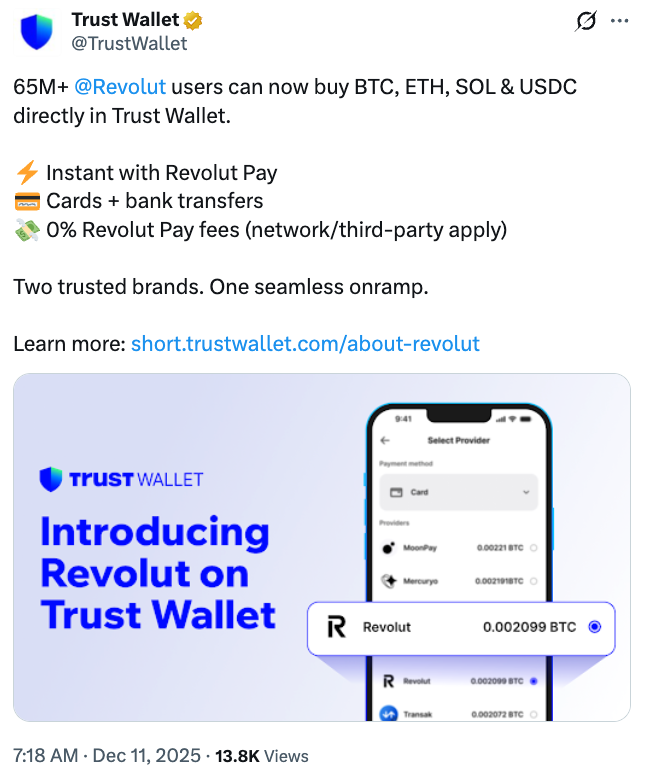
Source: Trust Wallet

While Revolut–Trust Wallet crypto purchases are offered with zero fees, adding money to a Revolut account is not free of charge in many cases, including via bank transfers, card top-ups and cash deposits. Cash deposits are subject to a 1.5% fee and are limited to $3,000 per calendar month, according to Revolut’s FAQs.

Related: Crypto self-custody is a fundamental right, says SEC’s Hester Peirce

The integration came shortly after Revolut secured a $75 billion company valuation after completing a private share sale in late November. “This makes us Europe’s most valuable private company and in the top 10 of the world’s most valuable private companies,” Revolut said in a post on X.

CZ-backed Trust Wallet has been actively tapping into trending market sectors, including prediction markets and real-world asset tokenization, expanding access to these offerings for self-custody users.

Cointelegraph contacted Revolut and Trust Wallet for comment on the integration, but had not received a response by publication.


Letture associate

The 20% Threshold Audit: Which of the Top 20 Cryptocurrencies Will Perish Under the CLARITY Act?

**Audit of the Top 20: Which Cryptocurrencies Will the CLARITY Act Kill?** Scheduled for a final push in December 2025, the U.S. CLARITY Act introduces a critical 20% threshold. If any single entity or affiliated party controls more than 20% of a network's token supply or validation power, the asset is classified as a "digital security" under the SEC's strict jurisdiction. If it remains below, it is a "digital commodity" under the more lenient CFTC. An audit of the top 20 cryptocurrencies reveals a stark divide: **The Safe Haven (Digital Commodities):** * **Bitcoin (BTC):** 0% control. The gold standard of decentralization. * **Ethereum (ETH):** <1% control. Highly dispersed validators and foundation holdings. * **Dogecoin (DOGE) & Litecoin (LTC):** Near 0% control. Their simple, early PoW issuance is now a major compliance advantage. **The Red Zone (At High Risk):** * **XRP:** High risk. Ripple's massive escrowed holdings could be deemed "entity-controlled." * **BNB:** High risk. Strong association with Binance exchange and its controlled burn mechanism. * **TON:** High risk. Historically concentrated supply from early mining. * **Sui & Aptos:** Extreme risk. Classic "VC coins" with teams, investors, and foundations holding over 50%. * **Layer 2 Tokens (e.g., ARB, OP):** Medium-High risk. Their DAO treasuries often hold 30-40+% of supply, which could be viewed as a single entity. **The Grey Zone:** * **Solana (SOL):** Its status is unclear. FTX's collapse dispersed supply, but the foundation and VC holdings remain a focus for regulators. The 360-day grace period will trigger a market reckoning. Projects may desperately airdrop or burn tokens to dilute control, accept a security" label and face liquidity death on major exchanges, or be preemptively delisted. The outcome will be a "gentrification" of crypto, splitting the market into compliant, institutional "digital commodities" and a shadowy world of illiquid "digital securities." Investors must now scrutinize token distribution or risk being locked out of liquidity.

marsbit1 min fa

The 20% Threshold Audit: Which of the Top 20 Cryptocurrencies Will Perish Under the CLARITY Act?

marsbit1 min fa

Trading

Spot
Futures
活动图片